Learn the Greek alphabet: letters, sounds and reading rules
Last updated 22 June 2026
The alphabet is the single best place to start — once you can read Greek, everything else gets easier. Modern Greek has 24 letters, and most learners read them within a week. Several already look familiar, so there’s far less to memorise than it first appears.
The 24 letters
🔊 Tap any letter to hear its name.
| Letter | Name | Sounds like | Watch out |
|---|---|---|---|
| Α α | álfa | a in father | |
| Β β | víta | v | not “b” |
| Γ γ | gámma | soft gh / y before e, i | throaty |
| Δ δ | délta | th in this | voiced |
| Ε ε | épsilon | e in pet | |
| Ζ ζ | zíta | z | |
| Η η | íta | i in machine | ”i”, not “h” |
| Θ θ | thíta | th in thin | unvoiced |
| Ι ι | yóta | i | |
| Κ κ | káppa | k | |
| Λ λ | lámda | l | |
| Μ μ | mi | m | |
| Ν ν | ni | n | |
| Ξ ξ | ksi | ks in books | |
| Ο ο | ómikron | o in got | |
| Π π | pi | p | |
| Ρ ρ | ro | rolled r | ”r”, not “p” |
| Σ σ/ς | sígma | s | ς at word-end, σ elsewhere |
| Τ τ | taf | t | |
| Υ υ | ípsilon | i | ”i”, not “u” |
| Φ φ | fi | f | |
| Χ χ | chi | ch in Scottish loch | not “x” |
| Ψ ψ | psi | ps in lapse | |
| Ω ω | oméga | o | ”o”, not “w” |
False friends to watch for
A few letters look like Latin letters but sound completely different — these cause more mistakes than anything else:
- Η η is “i”, not “h”.
- Ρ ρ is “r”, not “p”.
- Χ χ is “ch” (as in Scottish loch), not “x”.
- Υ υ is “i”, not “u”.
- Ω ω is “o”, not “w”.
Reading rules
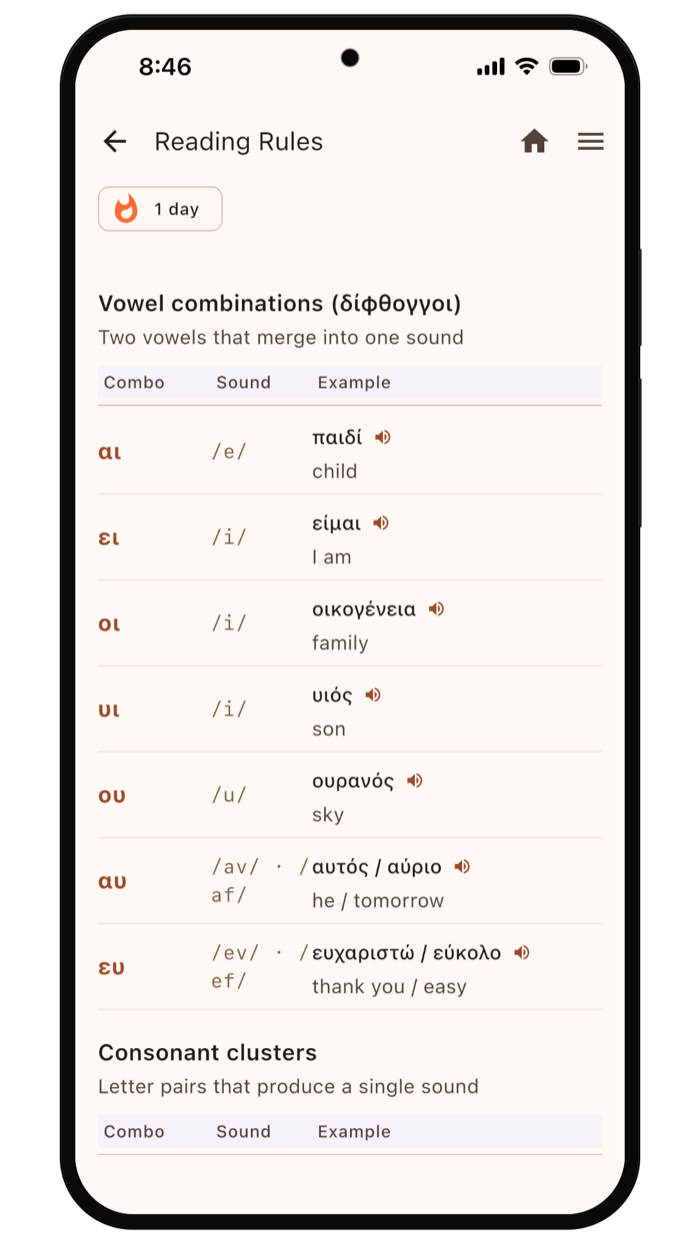
Once you know the letters, you can read almost anything — but a few combinations aren’t read letter-by-letter. These are the same rules the app teaches. 🔊 Tap any Greek word in the examples to hear it.
Vowel combinations (δίφθογγοι)
Two vowels that merge into one sound:
| Combination | Sound | Example |
|---|---|---|
| αι | ”e” as in pet | παιδί (child) |
| ει | ”i” as in machine | είμαι (I am) |
| οι | ”i” | οικογένεια (family) |
| υι | ”i” | υιός (son) |
| ου | ”oo” as in food | ουρανός (sky) |
| αυ | ”av” / “af” | αυτός / αύριο (he / tomorrow) |
| ευ | ”ev” / “ef” | ευχαριστώ / εύκολο (thank you / easy) |
αυ and ευ sound like “av/ev” before voiced sounds and “af/ef” before voiceless ones.
Consonant clusters
Letter pairs that produce a single sound:
| Combination | Sound | Example |
|---|---|---|
| μπ | ”b” / “mb” | μπαμπάς / λάμπα (dad / lamp) |
| ντ | ”d” / “nd” | ντομάτα / πάντα (tomato / always) |
| γκ | ”g” / “ng” | γκαρσόν / αγκαλιά (waiter / hug) |
| γγ | ”ng” | αγγλικά (English) |
| τσ | ”ts” | τσάι (tea) |
| τζ | ”dz” | τζατζίκι (tzatziki) |
| γχ | ”nch” | άγχος (stress) |
At the start of a word μπ / ντ / γκ sound like “b / d / g”; in the middle, like “mb / nd / ng”.
How Γ and Χ behave
Before front vowels (ε, ι, η, υ, ει, οι) the sound softens:
| Combination | Sound | Example |
|---|---|---|
| γ + ε/ι/η/υ | ”y” as in yes | γειά (hi) |
| χ + ε/ι/η/υ | soft “h” (German ich) | χέρι (hand) |
| γ + α/ο/ου | throaty “gh” | γάλα (milk) |
| χ + α/ο/ου | hard “ch” (Scottish loch) | χάρτης (map) |
A few quirks
- σ vs ς: sigma is written ς at the end of a word and σ everywhere else — same letter, two shapes.
- Several letters sound like “i” (Η, Ι, Υ, plus the combinations ει and οι). Context tells them apart; spelling is something you pick up with reading.
- Stress is marked with an accent (ά, έ, ή…), and it always tells you which syllable to emphasise. Greek spelling is otherwise highly consistent — once you know the letters, you can pronounce almost any word.
How to actually memorise it
Don’t just read the table once. Practise with spaced repetition until recognition is automatic, then immediately start sounding out real words — street signs, menus, brand names. Reading something every day, however simple, is what turns the letters from a chart into a reflex.
Lambda Lingua starts you at A1 with the alphabet and builds from there, with audio on every card so you hear each letter as you learn it — but any method that gets you reading daily will do the job.
The alphabet and reading rules in the app
The same reading rules live in Lambda Lingua — with audio on every word and spaced repetition so it actually sticks:
Next: how hard is Greek really?, how long it takes and the best way to learn Greek. Or see all Greek guides.
Frequently asked questions
How many letters are in the Greek alphabet?
Modern Greek has 24 letters, from alpha (Α) to omega (Ω). One of them, sigma, has two lowercase forms: ς at the end of a word and σ everywhere else — but it's still a single letter.
How long does it take to learn the Greek alphabet?
Most people can read all 24 letters within about a week of short daily practice. Several are already familiar from English, maths and science, so you're really only memorising a dozen or so new shapes plus a handful of 'false friends'.
Is the Greek alphabet hard to learn?
No — it's the easy part of Greek, and far less scary than it looks. About half the letters resemble Latin ones. What trips people up is the false friends: Η sounds like 'i' (not 'h'), Ρ like 'r' (not 'p'), Χ like 'ch' (not 'x'), and Υ like 'i' (not 'u').
Is the Modern Greek alphabet the same as Ancient Greek?
It's the same 24 letters. The main difference is the accents: Ancient Greek used several breathing and pitch marks, while Modern Greek (since 1982) uses a single stress accent that simply marks the emphasised syllable.
What's the difference between σ and ς?
They're the same letter — sigma. Write ς at the end of a word and σ in every other position. For example: σπίτι (house) starts with σ; Κώστας (a name) ends with ς.
How are combinations like αι, ου and μπ pronounced?
The main ones: αι → 'e' (παιδί sounds like 'pe-DEE'), ου → 'oo' (ουρανός), and ει/οι → 'i'. For consonants: μπ → 'b', ντ → 'd', γκ → 'g' at the start of a word (and 'mb/nd/ng' in the middle), τσ → 'ts', τζ → 'dz'. The full list is in the Reading rules section.